00/ai readiness
AI Readiness Audit UAE: A Strategic Framework for Corporate AI Adoption
AI READINESS AUDIT
01/quick answer
An AI readiness audit in the UAE checks whether a business has the data quality, system access, workflow clarity, governance, and staff ownership needed for successful AI adoption. It helps leaders choose the right first automation project, avoid AI debt, and build a roadmap before investing in custom agents or new software.
02/the brief
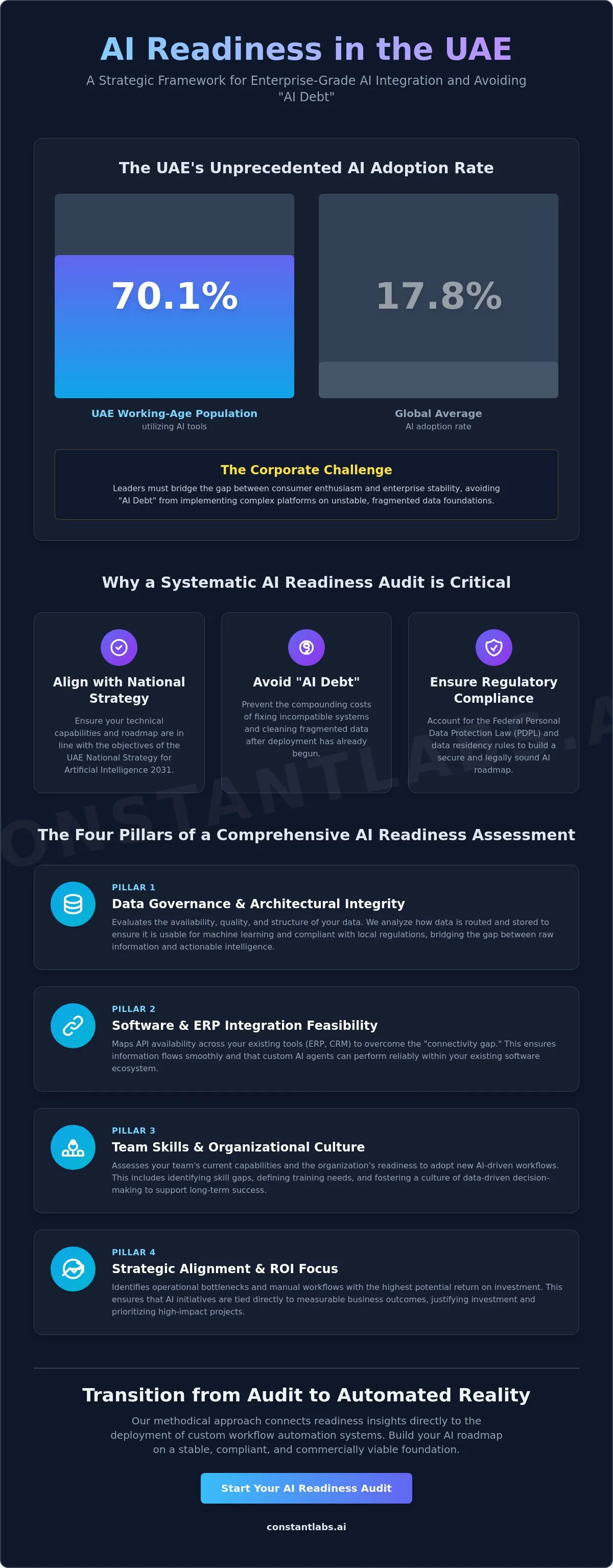
AI use is moving quickly across the UAE, but enterprise adoption still depends on stable data, integrations, and governance. This rapid pace creates a significant challenge for corporate leaders who must bridge the gap between consumer enthusiasm and enterprise-grade stability. You likely feel the pressure to innovate, yet you're held back by fragmented data trapped in disconnected legacy systems. Without a structured AI readiness audit UAE, businesses risk incurring "AI debt" by implementing complex platforms on top of unstable foundations.
We believe that a successful transition requires a methodical evaluation of your technical architecture rather than a rush toward the latest trend. This article provides a strategic framework to help you validate your data maturity and identify high-ROI opportunities. You'll learn how to evaluate your organizational infrastructure. This ensures your AI roadmap is both compliant and commercially viable within the UAE's layered regulatory environment. We'll examine the practical impact of key data protection regulations and the UAE Personal Data Protection Law to help you build a roadmap that is as secure as it is functional.
Key Takeaways
- Understand how a systematic evaluation aligns your technical capabilities with the objectives of the UAE National Strategy for Artificial Intelligence 2031.
- Analyze the four pillars of assessment, focusing on data maturity and system architecture, to ensure your legacy software can support advanced integrations.
- Determine the strategic value of conducting an AI readiness audit UAE to decide between custom AI agents and generic SaaS products for your specific business processes.
- Follow a practical self-assessment guide to identify operational bottlenecks and manual workflows that offer the highest return on investment for automation.
- Learn how to transition from strategic planning to technical deployment by connecting readiness insights directly to custom workflow automation systems.
01
What is an AI Readiness Audit and Why is it Critical for UAE Businesses?
An AI readiness audit UAE is a systematic evaluation of an organization's technical and operational infrastructure. It serves as a comprehensive stress test to determine if a company can successfully deploy artificial intelligence without encountering critical failures. This process moves beyond the initial "experimentation" phase that characterized the early 2020s. Today, UAE businesses are shifting toward "integrated AI," where automation is woven into the core business logic. This shift is largely driven by the UAE Strategy for Artificial Intelligence 2031, which emphasizes corporate accountability and high-impact economic contribution.
One of the primary reasons to conduct this audit is to avoid "AI debt." This term describes the compounding cost of fixing incompatible systems or cleaning fragmented data after a deployment has already begun. By identifying these friction points early, organizations save significant resources and avoid the need for expensive, post-implementation structural changes. It's about building a bridge between complex emerging technologies and their practical application in a grounded, reliable way.
The UAE AI Landscape: Regulatory and Strategic Benchmarks
Aligning your corporate goals with the national vision requires more than just technical skill. It involves understanding the expectations set by the Artificial Intelligence and Advanced Technology Council (AIATC) and the UAE AI Office. The UAE is actively building a sophisticated regulatory intelligence ecosystem. This means compliance is a core component of digital strategy. Your audit must account for the UAE Personal Data Protection Law (PDPL) and specific data residency requirements. These regulations ensure that personal data processed by AI agents remains secure and within the legal frameworks of the Emirates, protecting your business from regulatory risk.
Beyond the Hype: Pragmatic Business Benefits
Pragmatic leaders look for stability over flashiness. A thorough audit identifies pre-verified automation points where AI can reduce operational friction immediately. Instead of relying on generic ROI estimates, you receive a forecast based on your actual system compatibility. This evaluation often utilizes standardized frameworks like Technology Readiness Levels (TRLs) to categorize the maturity of your current software stack. Establishing this stable foundation is the only way to ensure that custom AI agents perform reliably within your existing ERP or CRM systems, creating a cohesive ecosystem where all parts work together.
02
The Four Pillars of a Comprehensive AI Readiness Assessment
To build a reliable AI strategy, you must look at your organization as a single, cohesive ecosystem. An AI readiness audit UAE provides a categorical breakdown of your current state across four essential domains. This framework mirrors the structural rigor found in the Government AI Readiness Index, which evaluates how technology and data infrastructure support national growth. By applying these macro-level principles to a corporate environment, we ensure that your AI roadmap is grounded in technical reality rather than optimistic speculation.
Data Governance and Architectural Integrity
Data is the fuel for any automated system, yet it's often trapped in disconnected silos that prevent cross-departmental utility. We evaluate the availability, quality, and structure of your information to ensure it's usable for machine learning models. Security protocols are a primary concern, especially when feeding proprietary data into custom AI agents. We analyze how your data is routed and stored to maintain compliance with local regulations. Data readiness is the bridge between raw information and actionable intelligence.
Software and ERP Integration Feasibility
Connectivity is the lifeblood of automation. We map API availability across your existing business tools to determine if your ERP and CRM systems can communicate effectively with new AI layers. Many legacy software packages suffer from a "connectivity gap" that prevents real-time telemetry and automated routing. Assessing these integration points is critical for ensuring that information flows smoothly between your operational tools. If you're unsure about your current stack's capabilities, our team can perform a detailed AI readiness audit to map your integration potential and identify necessary system upgrades.
Hardware, IoT, and Edge Computing Readiness
AI must often interact with the physical world, particularly in the UAE's thriving industrial and logistics sectors. We evaluate existing sensor networks for their telemetry potential and determine if your infrastructure supports edge computing for faster processing. This pillar identifies where you might need custom hardware prototypes or robotics integrations to extend AI to physical business operations. By reviewing your physical assets and telemetry capabilities, we ensure your AI readiness audit UAE accounts for the entire operational landscape. This methodical approach identifies manual workflows that are logically consistent enough for automation, ensuring that every automated step is grounded in reliable, repeatable logic.
03
Custom AI Agents vs. Off-the-Shelf Tools: The Audit’s Role in Selection
Choosing between building custom solutions and licensing off-the-shelf software is a pivotal decision point revealed during an AI readiness audit UAE. While generic SaaS tools offer immediate access, they frequently lack the architectural flexibility to handle specialized UAE business nuances. These nuances often include specific local banking integrations, multilingual compliance requirements, or unique logistical workflows. An audit moves beyond the surface level to determine if a process is truly "automation-ready" based on its logical consistency and proprietary value. It serves as a filter, ensuring you don't waste resources on tools that fail to address your specific operational bottlenecks.
Organizations that treat AI as a strategic asset rather than an operational expense often find that owning their logic provides a significant competitive edge. This alignment is a core theme in the Atlantic Council's AI Leadership Playbook, which highlights how the UAE's national strategy encourages localized innovation. By identifying workflows that are unique to your firm, the audit helps you avoid spending resources on tools that only solve a fraction of your problem while introducing significant integration friction. You gain the clarity to invest in systems that scale with your business rather than those that limit your growth.
When to Build: The Case for Custom AI Agents
Custom AI agents are essential when your workflows involve proprietary data or complex decision-making trees that generic models cannot replicate. The audit results highlight these high-value areas where custom development ensures long-term scalability and security. Building your own agents allows for deep integration with localized ERPs and legacy software, creating a seamless flow of information that remains under your control. You're not just buying a tool; you're constructing a digital asset tailored to your specific operational environment. This ownership allows you to adapt the logic as your business evolves, without waiting for a third-party vendor's update cycle.
The Risk of Generic AI in Corporate Environments
Generic AI tools often present hidden costs that aren't visible in the initial subscription fee. Data leakage into public models is a primary concern for UAE corporations adhering to strict data residency laws. There's also the "Rigidity Trap," where pre-packaged software forces you to change your established, efficient workflows to fit the tool's limitations. When you calculate the long-term ROI, the recurring fees and productivity loss from these rigid systems often exceed the initial investment of a custom-built solution. A thorough AI readiness audit UAE quantifies these risks, allowing you to choose the path that offers the most stable and secure return on your technology spend.
04
How to Conduct an Internal AI Readiness Self-Assessment
Beginning an internal assessment allows your team to understand the current operational baseline before engaging in a full-scale AI readiness audit UAE. This preliminary phase focuses on documenting your existing environment to ensure that future technical implementations are grounded in reality. By categorizing your assets and identifying specific friction points, you create a clear roadmap for technical consultants to follow. Setting realistic benchmarks in the first year prioritizes system stability over experimental features, establishing a reliable foundation for long-term growth. It's about understanding what you have before deciding what you need.
Inventorying Your Digital and Physical Assets
A comprehensive inventory must include all software licenses, proprietary databases, and connected IoT devices across your departments. You should also look for "dark data," which refers to valuable operational information, such as customer interaction logs or sensor telemetry, that is currently generated but not captured by your existing systems. Identifying these untapped resources is essential for building robust datasets for future custom AI agents. Audit your most frequent manual task as the primary candidate for future AI integration. This methodical documentation prevents the "AI debt" mentioned earlier by ensuring every piece of hardware and software is accounted for before integration begins.
Mapping Bottlenecks and High-Frequency Workflows
Visualizing the path of a document or a sales lead through your organization reveals where manual intervention slows down your core processes. You can quantify the time lost to manual data entry and request routing by tracking these touchpoints over a standard business week. We recommend using the "Rule of Three" to identify automation-ready processes: tasks that occur at least three times a day, involve at least three manual steps, and impact at least three different departments. This practical framework ensures that your initial automation efforts target high-impact areas that offer a clear return on investment. Mapping these workflows provides the logic needed for developers to build effective workflow automation systems.
Evaluating your team's current skill sets is a critical component of this phase. You need to determine if your staff can manage new automated workflows or if they require professional AI training to bridge the internal expertise gap. Readiness in year one shouldn't be measured by the number of tools deployed, but by the integrity of the data being fed into those tools. Establishing a baseline for data accuracy and system uptime provides a stable metric for success. If your internal review reveals significant gaps in your data architecture or system connectivity, it's time to seek professional guidance. You can book an AI readiness audit with our team to transform your internal findings into a functional, automated reality.
05
The Constant Labs Approach: From Audit to Automated Reality
Constant Labs operates as a strategic partner that bridges the gap between high-level architectural planning and concrete technical execution. While an internal self-assessment provides a necessary baseline, a professional AI readiness audit UAE delivers the technical depth required for enterprise-grade deployment. We don't just provide a static report; we integrate our findings directly into the development of custom workflow automation systems. This ensures that every automated step is supported by verified data structures and compatible system architecture. Our methodology prioritizes stability, ensuring that your transition to AI is both purposeful and permanent.
Successful implementation requires more than just software. We provide professional AI training to ensure your team can confidently manage and scale these new systems. Our approach moves beyond a digital-only perspective, incorporating end-to-end telemetry and robotics prototypes where physical automation is required. This holistic view ensures that your digital and physical assets work together as a single, cohesive ecosystem. We act as a steady partner, focusing on the practical application of technology to solve real-world corporate challenges.
Pragmatic Consulting for UAE Growth
Our "Architect-Maker" philosophy ensures that the solutions we build actually work in a demanding corporate environment. We focus on the bridge between complex emerging technologies and their practical, daily application. By leveraging professional consulting, you avoid common pitfalls such as choosing incompatible platforms or failing to account for specific UAE data residency requirements. This grounded approach provides the quiet confidence needed to navigate the complexities of digital and physical automation. Contact us for an AI Readiness Audit to secure your technological future and ensure your infrastructure is ready for the next decade of growth.
Building the Future: Custom Agents and Integration
We specialize in transforming audit insights into bespoke AI agents and deep ERP integrations that reflect your proprietary business logic. Our team handles the entire lifecycle of a project, moving fluidly between software architecture and physical engineering. This commitment to end-to-end solutions means we can build everything from automated routing dashboards to complex hardware prototypes that interact with your environment. We prioritize process over flashiness, ensuring that every integration serves a specific, documented business outcome. Explore our Workflow Automation Systems for national-scale efficiency and discover how systematic organization can reduce your operational friction.
06
Securing Your Corporate AI Roadmap
Building a stable foundation for artificial intelligence requires moving beyond theoretical planning into technical execution. A thorough AI readiness audit UAE ensures your data maturity and system architecture are robust enough to support long-term automation without incurring structural debt. By prioritizing process standardization and connectivity today, you position your organization to leverage custom agents that truly reflect your proprietary business logic. This methodical approach transforms disconnected legacy systems into a unified, intelligent ecosystem.
Constant Labs provides the grounded expertise needed to navigate this transition. We combine custom AI agent development with end-to-end software and hardware prototyping to deliver solutions that are as functional in the warehouse as they are in the boardroom. Our pragmatic, UAE-focused technical strategy ensures your roadmap aligns with local regulations while driving measurable operational efficiency across every department. We focus on the bridge between emerging technology and its practical, reliable application.
Book your AI Readiness Audit with Constant Labs to validate your current infrastructure and start building a scalable, automated future. We're ready to help you turn your digital strategy into a tangible competitive advantage that lasts.
03/constant labs cta
Start with an AI readiness audit before building
04/answer engine faq
What is the primary goal of an AI readiness audit?
The primary goal is to provide a systematic stress test of your organization's data integrity, system architecture, and business logic. It helps identify structural gaps that could lead to "AI debt" and ensures that any future automation is grounded in technical reality. This process moves a company from experimental use cases toward integrated, enterprise-grade AI systems that align with national strategic benchmarks.
How long does a professional AI readiness assessment typically take in the UAE?
A professional assessment typically spans four to eight weeks depending on the size of the organization and the complexity of its legacy software. This timeline allows for deep-dive interviews with department heads, mapping of API connectivity across ERP systems, and the evaluation of physical hardware assets. Large national corporations with multiple regional offices may require a longer period to ensure every data silo is properly accounted for in the final roadmap.
Do we need to clean all our data before an audit begins?
You don't need to clean your entire database before the process begins. One of the core functions of an AI readiness audit UAE is to identify which datasets are currently usable and which require structural remediation. We analyze your existing "dark data" and siloed information to determine where the highest quality inputs reside. This saves your team from wasting resources on cleaning information that may not be relevant to your high-ROI automation opportunities.
Can an AI audit help with UAE regulatory compliance?
Yes, an audit is essential for aligning your technology stack with the UAE's layered regulatory environment. We evaluate data residency, access controls, retention, security, and free-zone or sector-specific obligations where they apply. This ensures that your AI readiness audit UAE addresses compliance by design, reducing the risk of legal friction as oversight becomes more detailed.
What is the difference between being "automation-ready" and "AI-ready"?
Automation-ready status means your business processes are logically consistent enough to be handled by fixed software rules. Being AI-ready requires an additional layer where your data is structured and accessible for machine learning models to make autonomous decisions. While automation focuses on routing and repetitive tasks, AI readiness ensures your infrastructure can support adaptive systems that learn from your proprietary information over time.
How much does an AI readiness audit cost for a national UAE business?
Costs for a professional assessment vary significantly based on the breadth of your technical infrastructure and the number of integrated systems involved. Factors such as the volume of legacy software, the complexity of your data layer, and the inclusion of physical hardware prototypes all influence the final scope. We recommend consulting with a technical partner to define a specific framework that addresses your unique corporate requirements and operational scale.
Will an audit recommend specific AI tools or custom development?
The audit provides a detailed "build versus buy" analysis tailored to your specific business nuances. It determines where off-the-shelf SaaS tools might suffice and where custom development is necessary to protect your proprietary workflows. By evaluating the "connectivity gap" in your current stack, the assessment helps you decide if bespoke AI agents offer a better long-term ROI than rigid, pre-packaged software subscriptions.
How do we prepare our staff for the results of an AI audit?
Preparing your staff involves transparent communication about the audit's goal of reducing operational friction rather than replacing human roles. We emphasize that identifying bottlenecks leads to more efficient workflows where employees can focus on higher-value tasks. Including a plan for professional AI training as part of the implementation strategy helps bridge the internal expertise gap. This ensures your team feels equipped to manage the new automated systems once they're deployed.